
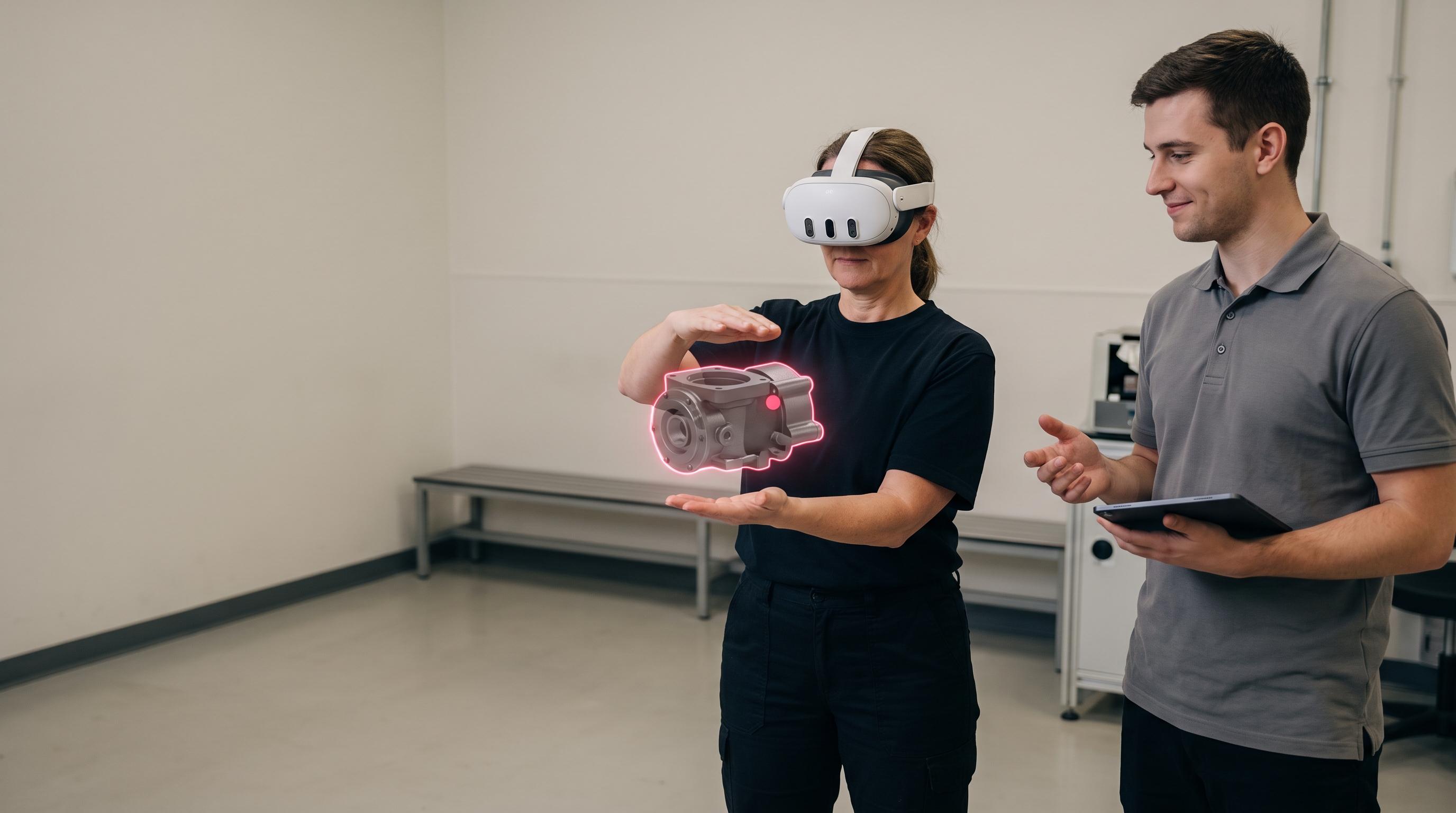
When roughly half your workforce says they have no time to train, a virtual reality training system earns its place on the rota by being time-efficient, not just engaging. PwC's enterprise study found VR learners completed the same soft skills course up to four times faster than in a classroom. So the honest test for an L&D leader is not whether a module is immersive. It is how many minutes it costs a frontline worker, and how many real decisions those minutes buy.
Is lack of time really the biggest barrier to workplace learning now?
Yes, and it has been for three years running. The 2026 TalentLMS L&D Benchmark Report found that for the third year running, employees say lack of time is their top obstacle to training.
The pressure is measurable. Sixty-five percent of employees say performance expectations have risen this year, yet lack of time remains the biggest barrier to learning.
A quick note on the numbers, because the framing matters. The widely quoted "half" figure describes learning leaders, not the whole workforce. Half of HR managers, 50 percent, say high workloads in their companies leave little room for training, even when it's needed. When you look at employees themselves the figures are similar but not identical: half of learning leaders and 53% of employees say heavy workloads leave little room for learning, even when it's needed. Either way, the direction is the same. The constraint is time, not appetite.
The June 2026 follow-up is blunter still. 44% say work priorities are pushing learning aside, while 27% say learning isn't integrated into daily work.
Why does this favour immersive training specifically?
Because the argument for immersive learning stops being about engagement and starts being about time. If a worker can only give you thirty minutes, the modality that packs the most useful practice into thirty minutes wins.
The most cited enterprise evidence comes from PwC. V-learners completed training four times faster than classroom training. That study is worth reading properly rather than quoting from a headline. It was a specific test: the largest study of VR soft skills training for a large-scale enterprise deployment, in which PwC gave new managers in 12 US locations the same unconscious bias training in one of three modalities: classroom, e-learning, or virtual reality.
Two caveats a careful buyer should hold onto. First, the four-times figure has an asterisk. When you account for the extra time needed for first-time learners to review, be fitted for and be taught to use the VR headset, V-learners still complete training three times faster than classroom learners. Three times is still a large saving, but plan for the first-timer overhead.
Second, it is a soft skills study. The speed finding is strongest for decision-and-conversation training, which is exactly the kind of thing that clogs a classroom rota.
What is the difference between engaging training and time-efficient training?
Engaging training holds attention. Time-efficient training returns competence per minute. They are not the same thing, and confusing them is how L&D budgets get wasted on impressive demos that do not survive the rota.
The TalentLMS data points at why immersive practice, done well, compresses time. Nearly a third of workers say their training is too theoretical, and 29% of employees forget their training almost immediately after it ends. Theory that is forgotten is not time-efficient at any length. It is pure cost.
The deeper problem the 2026 research names is speed-to-competency. Seventy percent of respondents say employees need faster ways to practice skills as job demands change. And the practice gap is severe: only 16% of respondents said skill-building happens quickly when new needs arise at their company, even though 70% agreed employees need faster ways to build skills.
“The question is no longer whether people want to learn. It is whether the learning fits inside a shift.”
How should an L&D leader judge a VR module against the minutes it costs?
Judge it on decisions per minute, not features per pound. A good immersive module puts the learner in front of the moments that actually go wrong on site, and lets them make the call, get it wrong safely, and try again. That is where the time saving comes from: you are cutting the travel, the waiting, the watching, and the passive listening, and keeping only the practice.
Here is a practical way to run the comparison.
Minutes on task. Count only the minutes the worker spends making decisions, not sitting through setup or theory. A module that costs 25 minutes and contains 20 decisions is doing more than a two-hour session with four.
First-timer overhead. Budget for headset fitting and orientation the first time, as PwC's three-times-faster figure accounts for. It largely disappears by the second session.
Scale economics. Immersive only pays back above a certain headcount. At 375 learners, VR training achieved cost parity with classroom learning, and at 3,000 learners VR costs become 52% less than classroom. Below those thresholds, be honest that a well-run classroom or a short e-learning module may be the better answer.
Decay. If the skill is used daily, retention takes care of itself. If it is a once-a-year high-consequence task, the emotional weight of immersive practice is where it earns its slot. V-learners felt 3.75 times more emotionally connected to the content than classroom learners and 2.3 times more connected than e-learners.
How do you choose the right format?
Often enough that it is worth saying plainly. If your problem is that people cannot find the right document, you have a content and findability problem, and a headset will not fix it. For HR leaders, finding the right content is a top obstacle, leading to unmotivated learners.
If the learning is genuinely happening in the flow of work already, formal training may be the wrong lever entirely. Over half of respondents, 53%, say they learn new skills by doing and figuring things out on their own. Sometimes the right move is a two-minute job aid at the point of need, not a module of any kind.
And below the scale thresholds above, immersive is hard to justify on cost. We would rather tell you that up front than build you something that never pays back.
Where immersive earns its slot is narrow and specific: high-consequence, low-frequency tasks; decisions that are hard to rehearse safely any other way; and situations where you need many people to reach competence quickly and consistently. That is the ground where a virtual reality training system wins on the one thing your workforce is actually short of, which is time.

Jamie founded Boundless Immersive in 2019 and has spent more than 20 years working in 3D, CAD and immersive technology.