
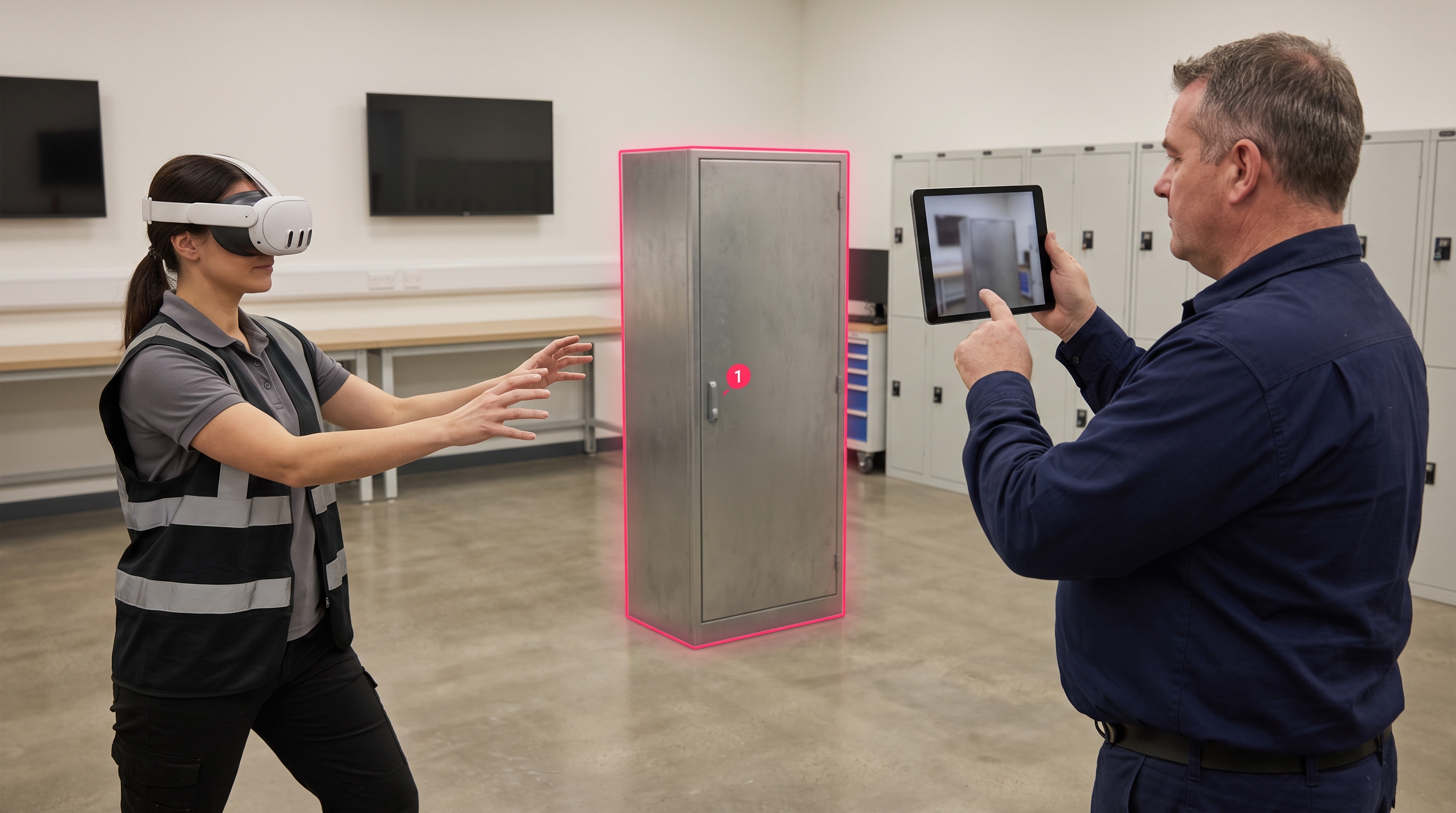
Every safety programme eventually asks the same question: should we train this in VR or AR? The honest answer is that they solve different problems. VR gives you a controlled rehearsal of a hazard. AR gives you guided support in the real environment. Choosing wrongly means either a training film with a viewport, or an overlay that never gets used in the field.
How VR reduces risk
VR isolates the learner in a fully simulated environment. That is exactly what you want when the hazard is too dangerous, too expensive, or too rare to rehearse for real: confined-space entry, arc-flash, working at height, LOTO on live plant, evacuation drills, or emergency response. Learners can fail safely, repeat the scenario until muscle memory forms, and be assessed against the same checklist every time.
The ROI case is usually straightforward: one avoided incident, one shorter shutdown window, or one certification cycle absorbed in-house typically pays back a rollout inside a year. That mirrors what our health and safety and technical training clients see when a scenario replaces a classroom module or an off-site practical.
How AR reduces risk
AR does its work where the hazard actually lives. A technician wearing a headset - or holding a phone - sees the real asset with contextual overlays: step-by-step procedures, torque values, isolation points, live sensor data, or a remote expert's annotations. The learning happens in the moment of the task, not in a classroom weeks before.
AR is strongest for procedural accuracy, first-time-fix rates, and situations where the cost of an error is high but the environment can be entered safely with the right guardrails. It also compresses the ramp-up curve for new hires and contractors doing unfamiliar work on familiar sites.
“VR rehearses the moment before it goes wrong. AR supports the person who has to get it right.”
A decision framework
Three questions get you to the right answer quickly. First: can the learner practise this hazard for real without unacceptable risk? If no, VR. Second: is the failure mode a knowledge gap in the moment of the task? If yes, AR. Third: does the work happen once, or every shift? Rare, high-consequence work rewards VR rehearsal; repeat work with variable conditions rewards AR assistance.
Many enterprise programmes end up using both - VR for initial competence and periodic refresh, AR for on-the-job support and audit trail. We run both formats through the same content pipeline, so a scenario authored once can be delivered as a VR simulation and an AR job aid without rebuilding the asset library.
What we would advise
Start with the hazard, not the hardware. Map the top three incidents or near-misses in the last twelve months, decide whether each is a rehearsal problem or a moment-of-task problem, and let that choose the format. The technology is the last decision, not the first.

Jamie founded Boundless Immersive in 2019 and has spent more than 20 years working in 3D, CAD and immersive technology.