
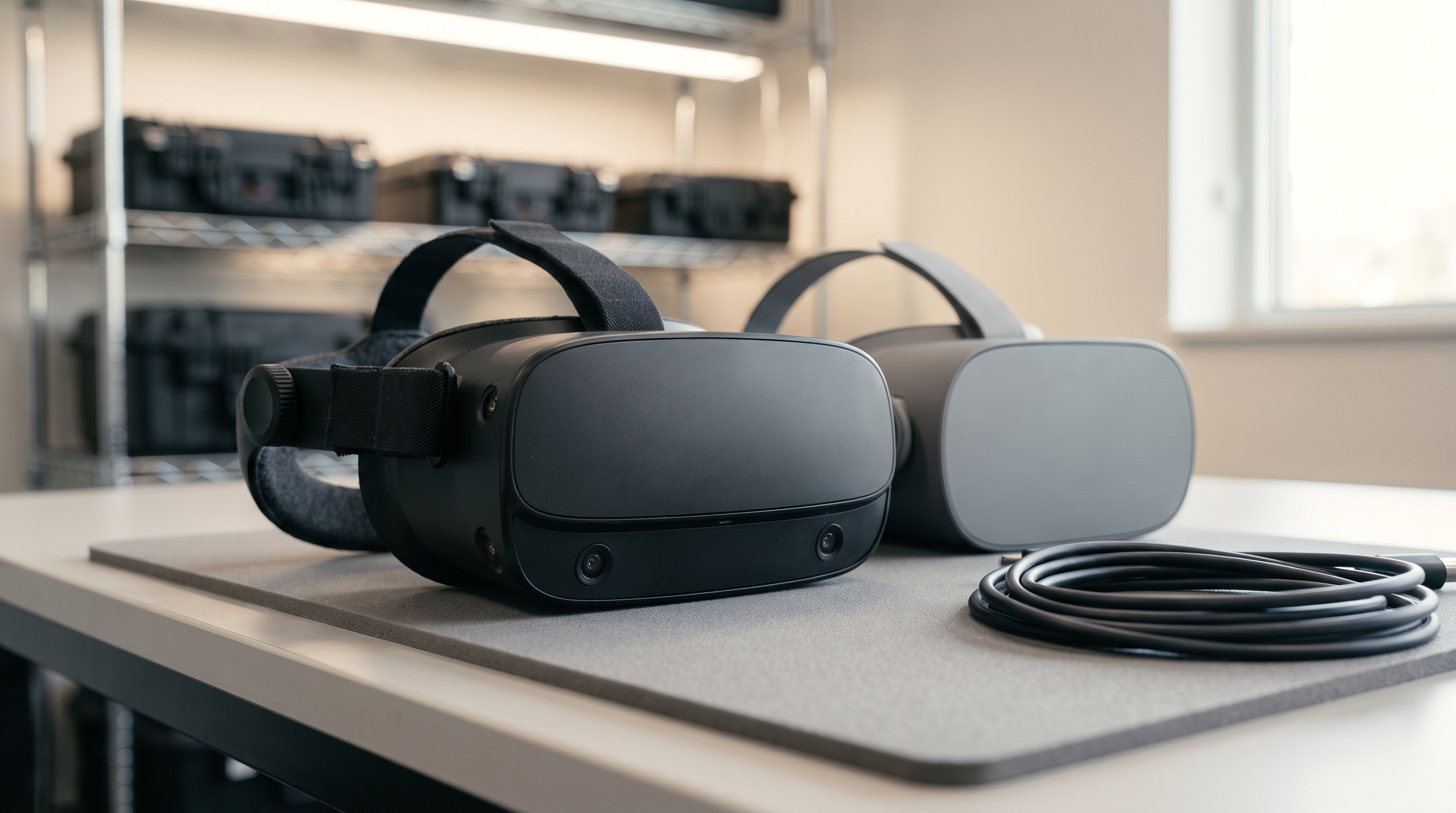
Every enterprise VR training rollout starts with the same fork in the road: 3DoF or 6DoF? The acronyms sound technical, but the decision is really about what you want learners to be able to do inside the headset - and how far your training needs to go beyond a video with a viewport.
The wrong choice quietly limits what your programme can teach. The right one lines up hardware, content, and outcomes so that the training actually earns its place next to classroom or on-the-job learning.
What 3DoF and 6DoF actually mean
DoF stands for degrees of freedom - the ways a headset can track a learner's movement in space.
3DoF (three degrees of freedom) tracks rotation only: pitch, yaw, and roll. You can look up, down, left, right, and tilt your head. If you take a step forward, the virtual world does not move with you. Learners are stationary observers inside a scene.
6DoF (six degrees of freedom) tracks rotation and translation: the three rotational axes plus movement forward/back, left/right, and up/down. Learners can walk around a virtual space, lean in to inspect something, crouch to look under it, and use tracked controllers or hands to interact with objects.
“3DoF puts learners inside a scene. 6DoF puts them inside a task.”
Where 3DoF earns its place
3DoF hardware - typically phone-based viewers or lightweight tethered headsets - is cheaper, easier to distribute, and simpler to support at scale. It shines when the training goal is exposure rather than practice.
Good fits for 3DoF include immersive inductions, safety awareness modules, empathy and perspective-taking experiences, brand or culture stories, and site or facility familiarisation. Anything where the learner's job is to observe carefully, notice what matters, and absorb a situation.
3DoF is also the pragmatic choice when you need to ship to thousands of learners across many locations with minimal IT overhead. The devices are quick to clean, quick to set up, and forgiving when a learner has never worn a headset before.
Where 6DoF is the only honest answer
6DoF is required whenever the training goal is skilled action - not just seeing a task, but doing it. Standalone 6DoF headsets like Meta Quest, Pico, and HTC Focus have made this level of fidelity practical for enterprise rollouts without the wires and PCs that used to come with it.
Reach for 6DoF when learners need to practise procedural skills (assembly, maintenance, medical procedures), operate equipment under load, respond to spatial hazards, navigate a real environment before entering it, or make decisions with their hands as well as their eyes. Muscle memory only forms when the body is genuinely doing the movement.
6DoF is also what unlocks assessment. If your training needs to show that a learner performed a task in the correct order, within tolerance, and safely, you need positional tracking of head and hands. 3DoF cannot measure that; it can only measure attention.
The trade-offs nobody puts on the spec sheet
6DoF costs more per unit, needs more space (a clear play area of roughly 2m x 2m for room-scale content), and asks more of learners physically. Some cohorts - night-shift teams, learners with mobility constraints, or environments with no free floor space - are genuinely better served by seated 6DoF or by 3DoF.
3DoF is cheaper but easier to outgrow. Teams often start with 3DoF for a first pilot, prove the appetite for immersive learning, and then hit a ceiling the moment they want to teach a hands-on skill. Planning for that transition from the start saves a rebuild later.
Content built for one is rarely a drop-in fit for the other. A 3DoF experience assumes the learner is anchored; a 6DoF experience assumes they can move. Retrofitting one into the other usually means rewriting the interaction design, not just changing an export setting.
A simple decision framework
Start with the outcome, not the hardware. Ask three questions:
1. Does the learner need to do something with their hands, or just witness something? Hands-on means 6DoF.
2. Does the learner need to move through space to understand the task? Spatial reasoning, hazard awareness, and site navigation all reward 6DoF. Static perspective-taking is fine on 3DoF.
3. Do you need to prove the learner performed the task correctly? Assessment based on movement or interaction requires 6DoF tracking data.
If any of the three is a yes, go 6DoF. If all three are no and the priority is scale, 3DoF is a defensible starting point.
How we approach the choice in client work
In practice, most enterprise programmes we build sit on 6DoF standalone headsets - usually Meta Quest - because the training goals almost always include some element of hands-on practice or spatial reasoning. When 3DoF is genuinely the right tool, we say so, and we shape the content to make the most of what 3DoF does well: attention, atmosphere, and unforgettable first impressions.
The headset is never the point. The learning outcome is. 3DoF and 6DoF are just two ways of putting a learner somewhere they could not otherwise be - and the choice between them should follow the job, not the other way around.

Jamie founded Boundless Immersive in 2019 and has spent more than 20 years working in 3D, CAD and immersive technology.